I’ve got to show roads some love. Without roads, I could not embark on this adventure. So here’s to the roads—my close, close companions.
My voyaging began in New England. I know those roads well, having lived there longer than anywhere else in the world. North and south, they run long; east and west, they’re short—especially in comparison with the continental sweep of the nation. Boston is the center—the biggest city and, in many ways, the region’s center of gravity, distorting everything around it like an astronomical black hole. Escape the city’s outer reaches and the highways quickly become unbusy. The ride to the White Mountains, the backwoods of Maine, or Vermont’s Northeast Kingdom is easy on modern, limited-access carriageways. These highways follow the engineer’s handbook: sweeping curves, measured rises, and descents without the runaway truck ramps common to western highways. Miles flow, the scenery is restful—wild enough, but dotted with snug small towns and tucked-in farms.
Boston has traffic. And idiosyncratic drivers—not the aggressive New Yorkers, but drivers who will cross from left to right without signaling because, well, is it Comm Ave or Newbury Street that now has outdoor dining intruding on the roadway? Boston traffic is nothing like that of car-centric cities such as Los Angeles, Phoenix, Houston, Atlanta, or even Washington. Only the new intersection of I-95 and I-93, at the edge of greater Boston near the big commuter rail station, hints at an auto city—an eight-lane spread. Each highway, nominally north and south, expresses opposite directions at the same time, with identifying signs for 95 N and 93 S on the same pole. For proud natives, however, it’s still Route 128, “America’s Technology Highway,” from the days of DEC, Prime, and The Soul of a New Machine—Data General. Are we at the singularity, with both compass directions in the exact same place?
I squirrel out of New England through Connecticut—the bane of New England automotive travelers. It’s the stopper. After New Haven, traffic constricts heading to New York and points south on I-95. To step up to I-84, the other east–west crossing, requires navigating secondary highways that suddenly become municipal roads with stoplights, unexpected turns, worrying low bridges for an RV, and meanders around natural or built features—a glacier’s rock outcrop or a surprise loading dock for an abandoned factory. Reaching Newtown, the highway becomes a glide into New York State and down into the Hudson Valley with Dutch names and reminders of pre-Revolutionary America— a time, place, and culture New Englanders tend to forget.
Avoiding the city to cross higher on the Hudson, I become lost in the nines when I step off the interstate. There’s 9W—not a westbound highway (that would violate the convention of odd numbers running north–south, even numbers east–west), but the western spur of Route 9. Then there’s the kaleidoscope of 9D, 9G, 9H, 9J, 9L, and possibly 9R. Their names give no hint of their identity and ensure that none but locals know which road leads where. With the quiet voice of the GPS, however, I navigate these routes that once frustrated me when using paper maps and make my way from Beacon to Storm King, then back to the interstate and out of New York to the west.
I hit my first concrete road with its regular expansion joints—thump, thump, thump—I feel them in the van. On a bike, they’re really felt. The driver grips the handlebars and feels the pavement’s irregularity in the wrists. The rhythm saps concentration, but there’s the throttle, brake, and stretch of arms. For the pillion rider, there’s no distraction—the thump, thadum, thump, thump like the click of a railroad car wheels induces sleep. The driver senses a slacking, an increased weight leaning in, as of a lover moving closer in bed. The arms about the waist loosen. A sudden movement could jar the rider awake, shifting weight and unbalancing the bike, or the rider might relax so much as to fall from the speeding machine. Grip the handlebars tighter; squeeze your arms around the passenger’s loosening hold. Slow, slow, slow the bike to move off the travel route, hoping the shoulder isn’t gravel. Bring it to an easy, quiet, controlled stop. No recrimination—just, by way of explanation, “I gotta pee. Maybe you should stretch your legs too.”
Pennsylvania, on its license plates and state documents and throughout its statehouse, calls itself the Keystone State. I’d rename it the Funnel. Highways through Pennsylvania lead from the Northeast to the West—and also to the South. Routes I-90, I-86, I-84, I-80, I-78, and I-76 (the historic Pennsylvania Turnpike, a technological advance in repurposing tunnels from an obsolete railroad line) all run east–west. North and south run I-81, I-83, I-95, and I-99, sneaking in the middle, violating the pure highway numbering logic—low numbers west, high numbers east. Only Indiana, with its hub-and-spoke model centered on Indianapolis, rivals Pennsylvania’s interstate connections. Trucks cluster and form convoys, jockeying so the slower ones move right on the hilly rises as engines grind against gravity.
Pennsylvania highways, however, are idiosyncratic. Whether it’s because modern routes overlay older roadways or just muddled engineering, the roads are different. Gettysburg became a battle site, in part, because roads and rail converged there—the Confederate armies marched from Virginia, while the Army of the Potomac mobilized from Maryland and Washington, supported by Union battalions from Pennsylvania, New York, and beyond. Highway exits can be short, straight shots from 65 mph roadways—200 yards terminating at a stoplight. Or, two exits later, outside populated areas, huge sweeping cloverleaf interchanges bounding lush green lawns, as though posing for a contemporary postcard—or, from a drone’s eye, the concrete curves look like a Cy Twombly chalkboard sketch—control traffic changing routes. I imagine the exacting colors of those modern postcards on carousels next to the historic cardboard cards with oversaturated reds and blues and overdressed women walking from plump fifties cars to the very travel centers where we are now spinning the metal frame.
Crossing through more recently expanded towns, the lanes suddenly narrow from the standard twelve feet to seemingly eight and a half, so the mirrors of large trucks appear to brush the roofs of sedans. What once might have been a median has become two high-speed lanes in opposite directions with negligible separation between them. Instead of Jersey barriers—designed to nudge an errant car back into its lane—or corrugated metal fences that crumple to absorb momentum, the lanes are separated only by three slack wires looping between angle-iron posts. I breathe easier and loosen my grip when the highway resumes its normal form—the lanes widen, shoulders appear to the right and left, and the median, America’s great lawn running from coast to coast, separates me from oncoming traffic.
I dip into Maryland. Uniquely, I find at-grade crossings—sometimes marked by a flashing light, more often just a signpost. At the posted speeds and on the map, I had expected a traditional limited-access highway, but here, crossing four traffic lanes are secondary roads butted directly to the main road, as though in a suburban neighborhood. But Maryland lies so close to Virginia and the capitol that bureaucratic order dictates design and the road soon becomes a looping, crowded ring road. The posted speed limit is aspirational—possibly achieved between 2 and 4 a.m. on a Tuesday or Thursday. And I crawl. Shift lanes, hopefully. And crawl again. Marking the red truck with a long tank of hazardous liquid—am I ahead? Yes. No. Yes. No. No. No. No. Yes. I exit to a sudden smoother ride, quickly traveling at more than the speed limit.
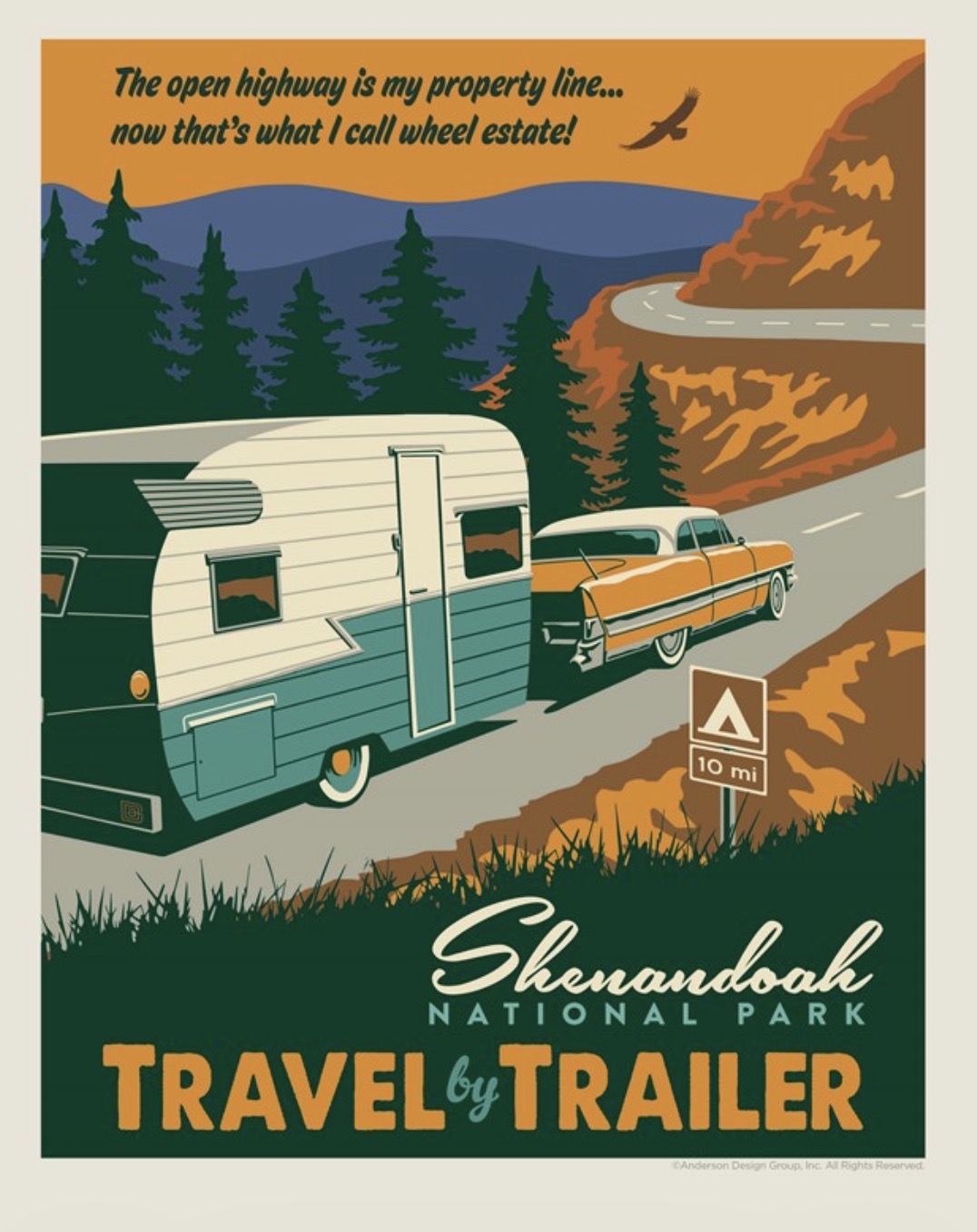
Shenandoah National Park, and left turn onto Skyline Drive. I enter the park designed for the automobile and the middle-class adventurer. The great national parks of the West relied on railroads to bring tourists—an early public–private partnership before that term became vogue. The East languished: fewer wild spaces, greater population densities, commuter rail rather than transcontinental sleepers—all made a national park seem anachronistic. But with proximity to Washington and the need for employment during the Great Depression, the Civilian Conservation Corps worked and shaped the parkways, resorts, campgrounds, and trails along the backbone of the Appalachians in the East. I am here to fulfill that dream.
Discover more from Ordinary Materials Project
Subscribe to get the latest posts sent to your email.
Hi Brett,
I followed you mentally on these roads. I kinda know them since we have been driving south to AL/GA for over 20 years or so several times per year and sometimes trying a new “turn” and not following GPS recommendations (but not to be born to be wild:)), just to use more map than tech. I do miss stopping and looking at a big map on the hood of a car (seemed to be more adventurous in the days). Keep looking for 70s. Love to you and the good dog.