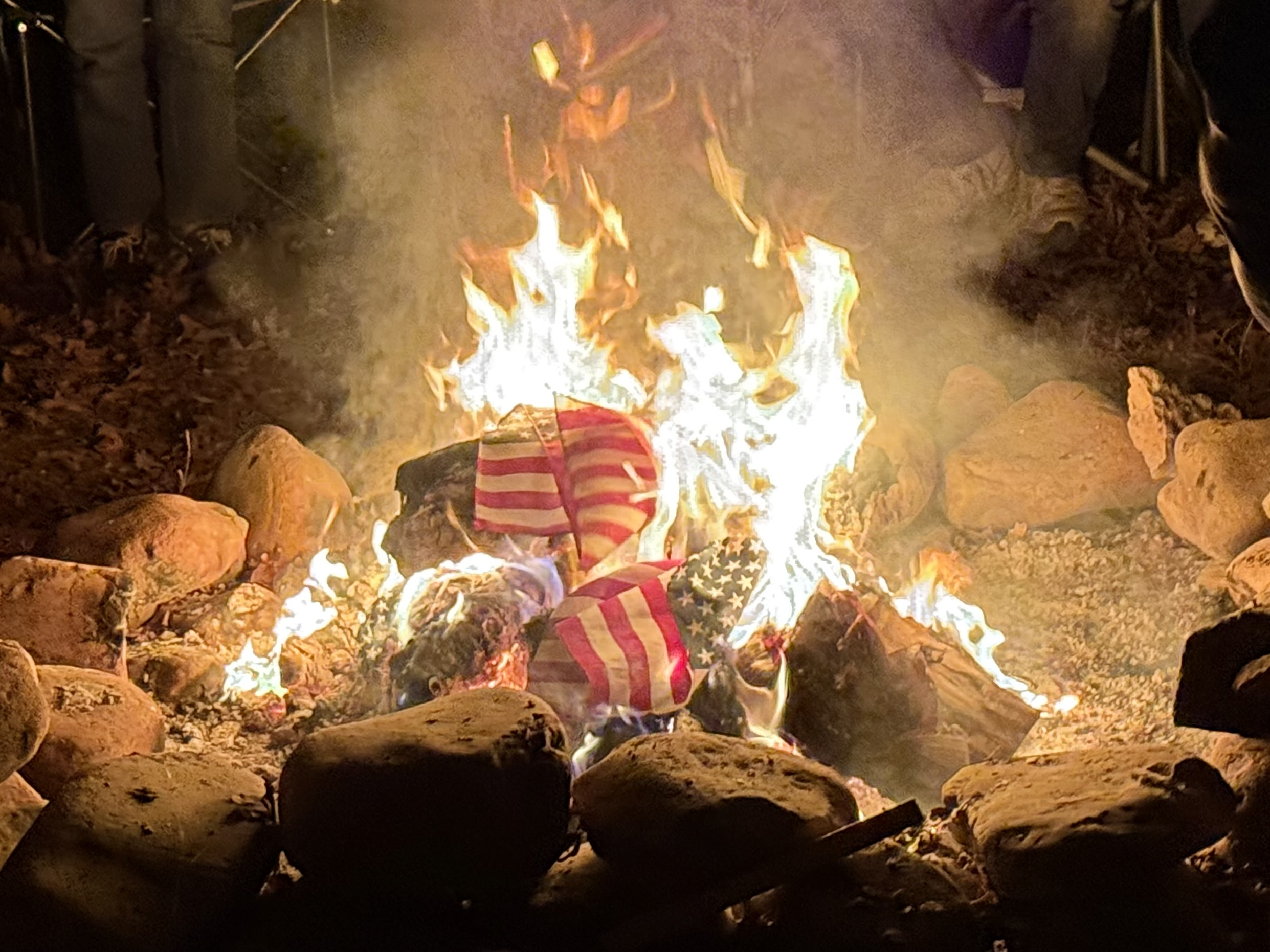
Three days of a foul nor’eater shredded the American flag flying at the South Yard of the marina where I keep my boat. One of my first stops on my tour south from New England will be joining a group of veterans at a campground in Tennessee where, among other activities, we will conduct a flag retirement ceremony. It seemed fitting that I should bring this Rhode Island–flown flag.
I am not nationalistic, especially in these times when fractures between nations and striking poses of unique national identity are on the rise. When I arrived in America as a teenager, I found the enthusiasm for flying the flag—on billboards, roadside attractions, bumper stickers, or a myriad other ways, in full or symbolically—remarkable. The stripes, the stars, the blue field lend themselves to an array of designer options, unlike many national flags that must be seen whole to represent the country. The America I discovered was unashamed of being in your face with the flag. Raquel Welch wore a flag swimsuit; Life magazine debated the appropriateness of an American flag patch covering a tear across the butt of a hippie’s blue jeans; the Boston Herald won a Pulitzer for the photograph of Joseph Rakes lunging at Ted Landsmark with a flag mounted on a staff at an anti-busing protest—an image with echoes of January 6th, some 44 years later. The American penchant for the flag seemed unique until I found myself in Toulouse with English soccer hooligans whose antics with the Union Jack and body paint rivaled their cousins across the pond, albeit a jingoistic parade fueled by beer.
The marina flagstaff stands on a promontory overlooking Tiverton Basin and Mount Hope Bay. I think maybe once or twice I have raised or lowered a flag on a flagpole. I did attend a ceremony where I very much wanted to be the one raising the flag, but I didn’t get the chance—fortunately, perhaps, as it was a windier day than expected, and as the flag rose the wind rose with it, turning managing the banner into a struggle.
Today, I stood alone on the edge of the bay and felt an unexpected pride looking at the flag—split in four sections along the white stripes—that I was about to lower. I saw Fort McHenry, the Barbary Pirates, Utagawa’s woodcut of Perry’s Black Ships in Tokyo Bay, the moon landing with its arm projecting from the staff to hold out the flag, and images of flag-draped coffins too numerous to list. I lowered the flag, careful not to let it touch the ground.
The new flag was crisp, in brighter, more saturated colors than the one it replaced. I raised it slowly, thinking this time about the banners in Childe Hassam paintings, Jasper Johns’ flag (and his white flag), and Walt Whitman’s simple poem, America:
America
Center of equal daughters, equal sons,
All, all alike endear’d, grown, ungrown young or old,
Strong, ample, fair, enduring, capable, rich,
Perennial with the Earth, with Freedom, Law and Love,
A grand, sane, towering, seated Mother,
Chair’d in the adamant of Time
Discover more from Ordinary Materials Project
Subscribe to get the latest posts sent to your email.
Recent Comments