I knew sometime on my travels south I would cross wakes with Native American/US history. In New England their memory was all about us in places: Sakonnet Point, Wampanoag Trail, Narragansett Bay, or Aquidneck Island (for a time Rhode Island); in foods: quahog, tautog, or succotash; in culture: powwow, wampum, or sachem. But their presence as a people had only been at special events, although more recently they have made the news and their presence is growing, and not just for tribal casinos or tax-free cigarettes. Land acknowledgements, such as the one I worked on for Roger Williams University, helped to “unvanish” the tribes that populated the area before the arrival of the English and their subsequent erasure in King Phillip’s War.
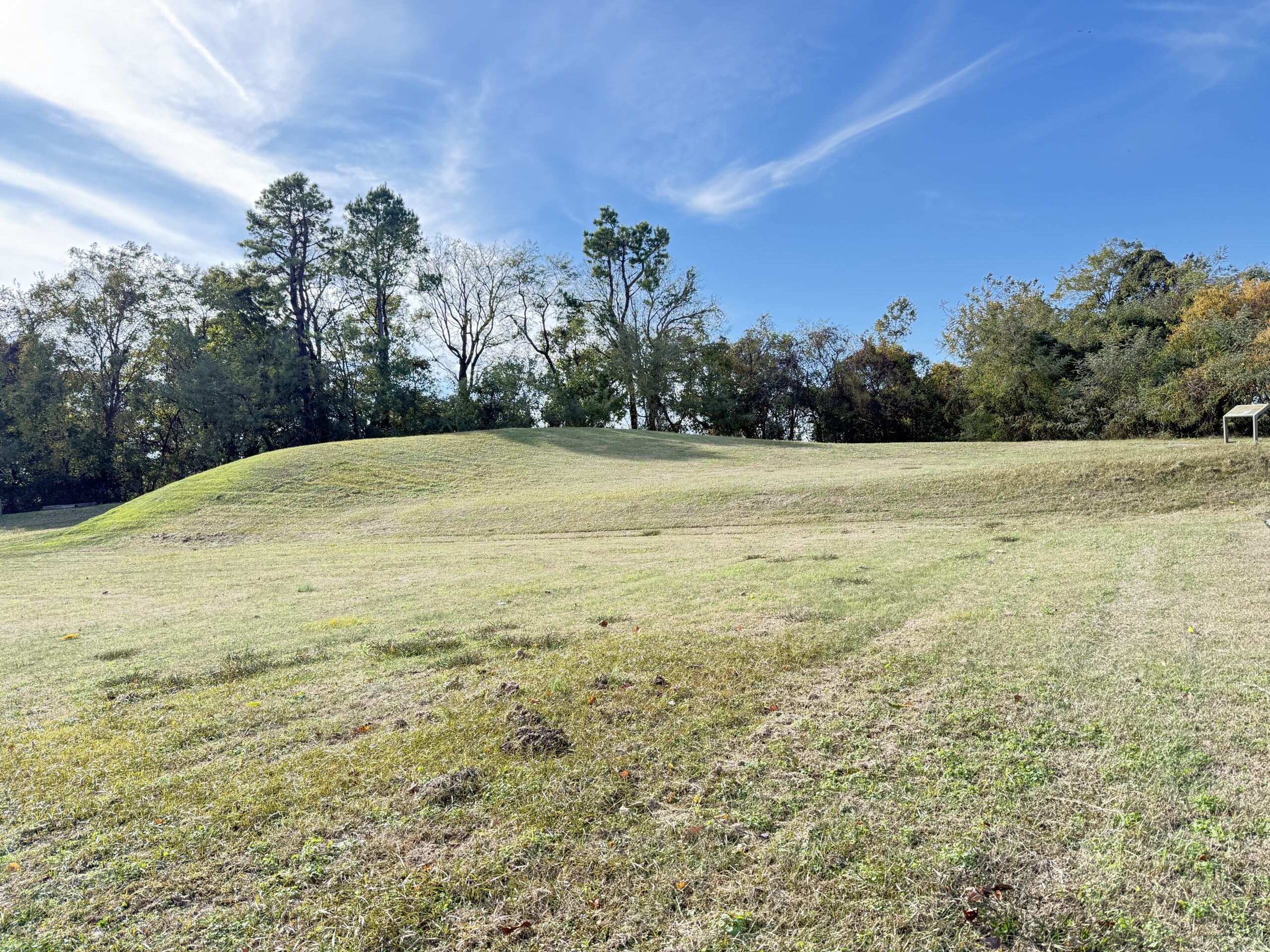
Today, I visited Chucalissa, a mound settlement and archeological museum managed by the University of Memphis. I arrived via an industrial space I have not seen at a city’s edge in my travels to date. When you leave the highway, a line of tanker trucks wait the length of the exit ramp to fill at the Valero refinery on McKellar Lake, a loop off the Mississippi. Next is the Fleishman’s Yeast Factory, then other industrial plants ending with the outsized Easley Engineer Yard which is the Army Corps of Engineers facility to maintain the port of Memphis. A sudden left turn, and all industry vanishes by entering narrow roads and wooded lands of Foley State Park. This was the park developed under the “separate but equal” doctrine for Black Memphians as the alternative to Shelby Forrest.
I had wanted to visit a Native American mound site (a full exploration will await another trip, this was just a quick opportunity for reference). Jared Diamond, I think, noted that Europeans struggle to acknowledge the scope and sophistication of people who built with organic material. Our sense of civilization’s history was warped by early explorations in Egypt and Iran where the climates are dry, tending to preserve more, and that the cultures built with stone that long outlasted their regimes. Consequently, the current evidence of native peoples building with wood is scant, only fragments, most frequently, stone arrow heads, spear points, scrapers and axes. High altitude mapping has shown unexpected changes in the landscape that indicates human hand upon the land. These are often the sites for the ancient mounds, remnants of towns populated by the first peoples of America.
Discover more from Ordinary Materials Project
Subscribe to get the latest posts sent to your email.
Fantastic, I wish I had been with you to experience all of this!
There are gaping holes in my understanding of America — immersed in the Colonial period in New England, can make you arrogant about what you know. This visit has been exciting and humbling.